Why Does My Baby Only Take 30-Minute Naps? And How to Help Them Nap Longer
Published by Restored Nights Sleep Consulting
If your baby wakes after almost exactly 30 minutes—bright-eyed, upset, or somehow both—you are in very good company.
Short naps are one of the most common sleep frustrations during infancy. Your baby may still seem tired, the rest of the schedule becomes harder to manage, and you can spend the whole day feeling as though you are constantly preparing for the next nap.
The reassuring news is that a 30-minute nap does not automatically mean something is wrong. Short naps can be a normal part of sleep development, particularly during the first several months. They can also offer useful clues about your baby’s schedule, sleep environment, or ability to settle between sleep cycles.
Let’s look at why short naps happen, what your baby’s mood after waking may tell you, and which practical adjustments are worth trying.
Quick Takeaways
A 30-minute nap can be developmentally normal.
Your baby’s mood after waking may offer useful clues.
Both too little and too much awake time can contribute to short naps.
Sleep environment and nap timing are worth reviewing first.
Change one or two things at a time and watch for patterns.
Contact your pediatrician when short naps accompany feeding, breathing, growth, pain, or illness concerns.
Why Do Babies Wake After 30 Minutes?
Babies move through lighter and deeper stages of sleep. Their sleep cycles are shorter than an adult’s, and many babies become easier to wake as one cycle ends. Sleep patterns also remain immature during early infancy and become more organized over time.
At the end of a cycle, your baby may:
transition into another cycle and continue sleeping;
stir briefly before resettling; or
wake fully and signal for you.
That brief transition is often where a short nap ends. Your baby may not yet be developmentally ready to connect daytime sleep cycles consistently, or something about the timing or conditions of the nap may be making that transition harder.
Are 30-Minute Naps Normal?
They certainly can be.
Babies do not all develop predictable sleep at the same pace. Newborns commonly sleep in short stretches, and regular sleep cycles are still developing during the first several months. The American Academy of Pediatrics also emphasizes that babies have different individual sleep needs.
A short nap may not require fixing when your baby:
wakes content and alert;
is generally comfortable between naps;
is feeding and growing appropriately;
receives enough total sleep across the full day and night; and
has a mixture of shorter and longer naps.
For context, the American Academy of Sleep Medicine recommends that infants ages 4–12 months receive approximately 12–16 total hours of sleep in 24 hours, including naps. The distribution between daytime and nighttime sleep can vary considerably from one baby to another.
Instead of judging one nap in isolation, look at the larger picture: your baby’s age, mood, feeding, nighttime sleep, total sleep, and patterns across several days.
What Your Baby’s Mood After a Short Nap May Tell You
The way your baby wakes can provide a helpful clue, although it is not a foolproof diagnostic test.
Your baby wakes happy and ready to play
A cheerful wake-up may mean the nap met your baby’s immediate sleep need. It could also suggest that your baby went down before enough sleep pressure had built to support a longer nap.
Your baby wakes crying and still looks exhausted
An upset, tired wake-up may suggest your baby had difficulty moving into another sleep cycle. Overtiredness, discomfort, hunger, environmental stimulation, or simply immature sleep organization could all contribute.
Your baby wakes inconsistently
Some naps are short, others are longer, and there is no obvious pattern. This is extremely common, particularly during developmental changes, nap transitions, illness, travel, or periods when your baby is learning a new physical skill.
The goal is not to decode every nap perfectly. It is to notice repeated patterns that can guide your next step.
Common Reasons Babies Take Short Naps
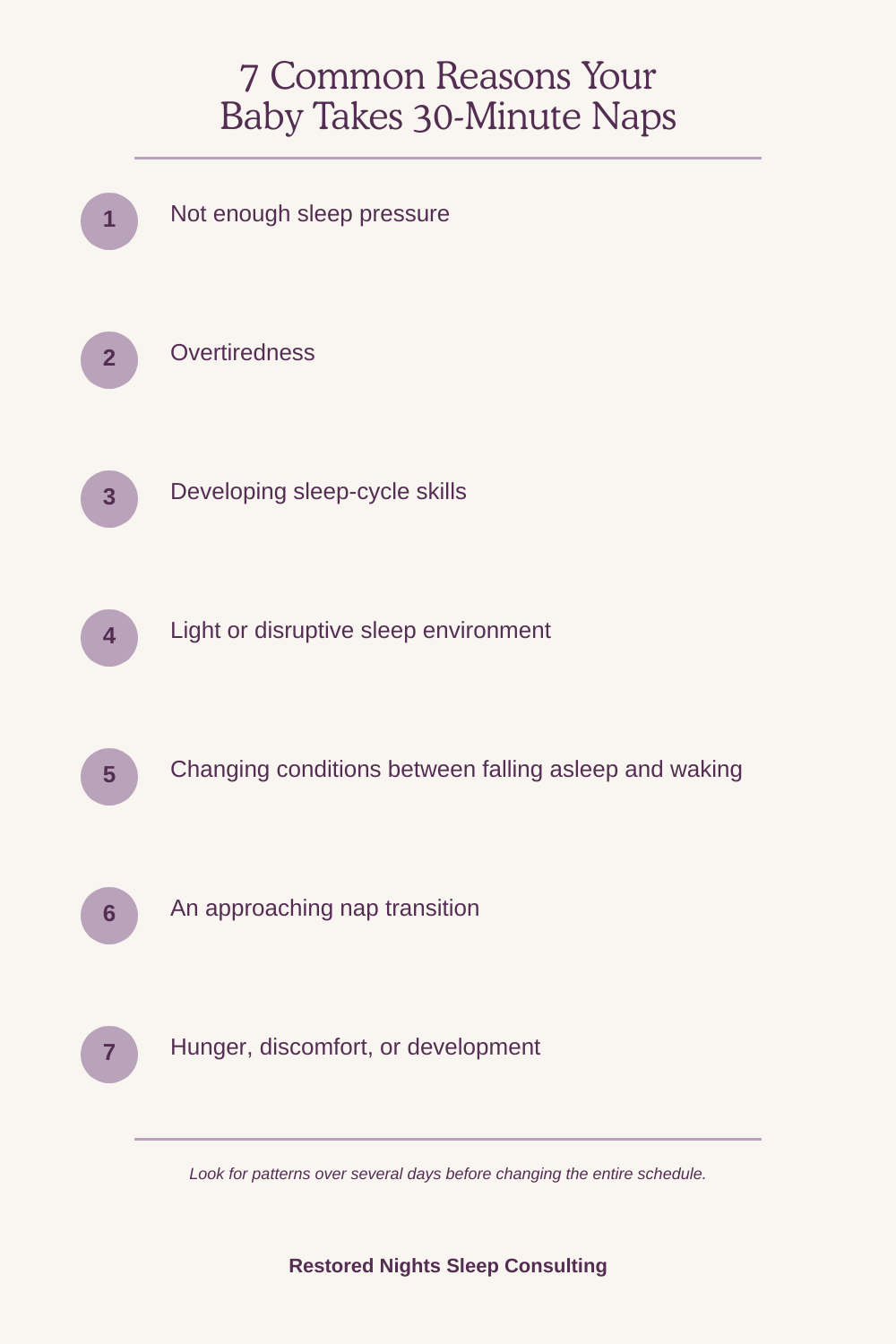
1. Your baby may not be tired enough yet
If the nap begins before your baby has built enough sleep pressure, they may complete one sleep cycle and wake ready to continue the day.
Possible signs include:
taking a long time to fall asleep;
playing or babbling in the crib;
waking happy after a short nap; or
consistently resisting the nap altogether.
Before making a major schedule change, try a small adjustment and observe the pattern for several days.
2. Your baby may be overtired
Keeping a baby awake longer does not always produce a longer nap. When a baby becomes overtired, settling can become harder and sleep may be more fragmented.
You may notice:
fussiness before the nap;
frantic or restless behavior;
falling asleep almost immediately from exhaustion;
waking upset after one short cycle; or
a series of short naps that makes the day progressively harder.
This is why wake windows are best treated as flexible guidelines—not rigid targets that must be stretched at all costs.
3. Your baby is still learning to transition between sleep cycles
Sometimes there is no schedule mistake to uncover. Your baby’s sleep system may simply need more time to mature.
HealthyChildren notes that babies’ sleep cycles become more regular as they grow, and individual sleep needs vary.
A baby may connect cycles one day and wake after 30 minutes the next. That inconsistency can be frustrating, but it is often developmentally normal.
4. The sleep environment may be interrupting the transition
At the end of a sleep cycle, your baby moves into lighter sleep and may be more sensitive to light, sound, temperature, or activity outside the room.
Consider whether the nap space is:
dark enough to limit visual stimulation;
comfortably cool;
protected from sudden household noise;
consistent from day to day; and
set up according to current safe-sleep recommendations.
Always place your baby on their back on a firm, flat sleep surface with no loose blankets, pillows, bumpers, toys, or other soft objects in the sleep space. Safe-sleep practices apply to naps as well as nighttime sleep.
5. Your baby may notice that the conditions have changed
If your baby falls asleep while feeding, rocking, bouncing, or being held and then wakes somewhere different, they may signal for the same support they had at the beginning of the nap.
This does not mean you have created a bad habit or done anything wrong. Feeding and rocking are normal, loving ways to comfort a baby.
It simply means that, if longer independent naps are your goal, the way your baby begins the nap may be one part of the bigger picture. For babies around 4 months and older, the AAP suggests placing babies down while drowsy rather than waiting until they are fully asleep as one way to help them practice falling asleep in their own sleep space.
How you approach this should reflect your baby’s age, temperament, feeding needs, and your family’s preferences.
6. The nap schedule may be changing
Short naps sometimes appear when a baby is nearing a nap transition.
For example, a baby who is beginning to outgrow three naps may resist sleep, take shorter naps, or struggle to fit the final nap into the day. But one or two unusual days are not enough to confirm a transition.
Look for patterns that continue for at least a week or two before making a significant schedule change.
Related article:When Should My Baby Drop to Two Naps? Signs They’re Ready—and Signs They Aren’t
7. Hunger, discomfort, or development may be involved
Sometimes the explanation is less about sleep strategy and more about what your baby is experiencing physically or developmentally.
Short naps may temporarily appear alongside:
growth spurts;
changing feeding needs;
illness or congestion;
teething discomfort;
reflux or other discomfort;
travel;
new motor skills; or
developmental changes.
A sleep schedule cannot override hunger, pain, illness, or a need for comfort. When something feels unusual for your child, step back and look at the whole baby—not only the nap.
Short Naps Might Be Only One Piece of the Puzzle
If you’re also navigating bedtime struggles, frequent night wakings, or unpredictable sleep, my free guide (5 Common Sleep Mistakes That Keep Families Stuck) can help you take a step back and look at the bigger picture.
Click the button below to get practical, evidence-based guidance to help you identify where to start—without trying to change everything at once.
How to Help Your Baby Nap Longer
You do not need to overhaul everything at once. In fact, changing several variables simultaneously can make it harder to determine what is helping.
Choose one or two reasonable adjustments and observe the pattern over several days.
Start with the timing
Look at how your baby behaves before and after the nap.
If your baby regularly takes a long time to fall asleep and wakes cheerful, consider whether the nap may be starting slightly too early.
If your baby is melting down, falling asleep from exhaustion, or waking distraught, consider whether the nap may need to begin a little sooner.
Make small shifts rather than dramatically stretching or shortening the entire schedule.
Use a brief, predictable nap routine
A nap routine does not need to be elaborate. Five to ten calm minutes can be enough to signal that sleep is approaching.
For example:
diaper change;
dim the lights;
put on the sleep sack;
turn on white noise;
read a short book or sing one song;
place your baby in their safe sleep space.
Consistency helps make the transition into sleep more familiar, even when the nap length itself remains unpredictable.
Protect the sleep environment
Darkness and steady background sound may make it easier for some babies to move through a period of lighter sleep without fully waking.
Keep the room comfortable, use an age-appropriate safe sleep space, and avoid relying on products that conflict with safe-sleep guidance.
Pause briefly before ending the nap
When your baby wakes, you do not always have to rush in at the first sound.
A short pause may give them an opportunity to stir, reposition, or settle again. This is not the same as ignoring prolonged distress. If your baby is escalating, appears uncomfortable, or needs you, respond.
The appropriate pause will look different depending on your baby’s age, temperament, and your comfort level.
Practice with one nap first
The first nap of the day is often the easiest place to experiment because sleep pressure may be more predictable and the day has not yet been affected by several short naps.
Rather than trying to lengthen every nap immediately, focus on creating a consistent setup for one nap. That gives both you and your baby a manageable place to practice.
Rescue a nap when your family needs it
Sometimes extending a nap through contact, rocking, or motion is the most practical choice—particularly when your baby is young, sick, adjusting to a transition, or accumulating overtiredness.
Helping your baby finish a nap does not erase their progress.
You can support rest when it is needed while also creating gradual opportunities to practice sleeping in the crib. Those approaches are not mutually exclusive.
What Usually Does Not Help
Changing the schedule every day
Sleep needs fluctuate, but constantly making large adjustments based on one nap can create more confusion. Look for repeated patterns before changing course.
Stretching wake windows aggressively
More awake time is not automatically better. A schedule that works should support your baby—not require them to struggle through the day.
Expecting every nap to be long
Even babies who generally nap well may have one short nap, especially later in the day. Total sleep and overall well-being matter more than making every nap identical.
Comparing your baby to a sample schedule online
Sample schedules can be helpful starting points, but they cannot account for your baby’s temperament, feeding, development, health, nighttime sleep, or individual sleep needs.
When Should You Talk With Your Pediatrician?
Sleep challenges are often behavioral or developmental, but it is important to involve your child’s healthcare provider when something seems medically concerning.
Contact your pediatrician if short naps occur along with:
poor feeding or difficulty gaining weight;
persistent vomiting or signs of significant reflux;
breathing pauses, persistent snoring, gasping, or labored breathing;
unusual lethargy or difficulty waking;
frequent signs of pain;
ongoing congestion or illness;
fewer wet diapers than expected; or
a sudden, significant change from your baby’s usual behavior.
You should also reach out whenever your instincts tell you something is not right. Sleep advice is not a substitute for individualized medical care.
Frequently Asked Questions
At what age do babies begin taking longer naps?
There is no single age when naps suddenly lengthen for every baby. Sleep often becomes more organized after the newborn period, and many families notice more predictable naps as their baby moves through the middle of the first year. However, variation is normal.
Is a 30-minute nap ever enough?
Yes. One short nap can be appropriate depending on your baby’s age, the time of day, their mood after waking, and how much total sleep they receive in 24 hours.
Should I try to extend every short nap?
No. You may decide to extend a nap when your baby still seems exhausted or the day is becoming difficult, but you do not need to rescue every nap. Consider the full day rather than treating each short nap as an emergency.
Should I feed my baby back to sleep?
Feeding your baby is appropriate when they are hungry, and feeding can be a comforting way to help a young baby sleep. Whether you want to use feeding to extend a nap depends on your baby’s needs and your family’s goals. If feeding, growth, or reflux is a concern, consult your pediatrician.
Do blackout curtains and white noise fix short naps?
They may help reduce environmental disruptions, but they cannot guarantee a longer nap. Nap length also depends on development, timing, sleep pressure, comfort, and individual sleep needs.
Lauren’s Gentle Reminder
A short nap is information—not a verdict on your parenting or your baby’s ability to sleep.
Your baby does not need to follow an online schedule exactly, and you do not have to solve every nap in a single day. Look for patterns, make thoughtful adjustments, and give both of you time to adapt.
Small, consistent changes are often more useful than repeatedly starting over.
Want a Clearer Place to Start?
If naps, bedtime, and night wakings all feel tangled together, my free guide can help you identify some of the most common patterns that may be keeping your family stuck.
Download the Free Sleep Guide
5 Common Sleep Mistakes That Keep Families Stuck—and What to Do Instead
You’ll receive practical, evidence-based guidance you can begin using today.
Still Struggling With Short Naps?
A general article can help you understand the possibilities, but it cannot account for your baby’s complete schedule, temperament, feeding, sleep environment, developmental stage, and your family’s goals.
If you have tried making thoughtful adjustments and still feel stuck, personalized support can help you identify which pieces are most relevant for your child—without changing everything at once.

About Lauren
Lauren Drukenbrod is a Certified Pediatric Sleep Consultant, Newborn Sleep Specialist, and Certified Potty Training Consultant. Through Restored Nights Sleep Consulting, she provides practical, personalized, evidence-based support to families navigating newborn, baby, and toddler sleep challenges.
📍 Franklin, Tennessee
🌙 Virtual consultations nationwide